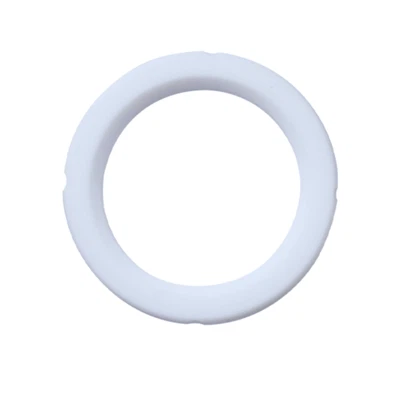
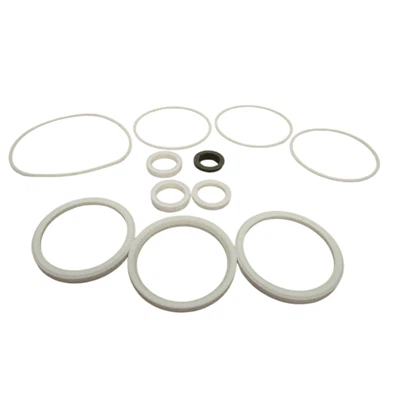
Resilience is a critical property when it comes to the performance of rptfe (Reinforced Expanded Polytetrafluoroethylene) gaskets in sealing applications. As a supplier of rptfe gaskets, I've witnessed firsthand how the resilience of these gaskets significantly contributes to effective sealing. In this blog, I'll delve into the science behind the resilience of rptfe gaskets and how it plays a pivotal role in sealing various systems.
Understanding Resilience in rptfe Gaskets
Resilience can be defined as the ability of a material to absorb energy when deformed elastically and then release that energy upon unloading. In the context of rptfe gaskets, resilience allows the gasket to recover its original shape after being compressed between two mating flanges. This property is essential because it ensures that the gasket maintains a consistent seal over time, even under varying operating conditions.
The unique structure of rptfe contributes to its remarkable resilience. Expanded polytetrafluoroethylene (ePTFE) is a porous material with a network of interconnected fibrils. When reinforced with appropriate materials, such as glass fibers or stainless - steel mesh, the rptfe gasket gains enhanced mechanical strength and resilience. The reinforcement materials help distribute the compressive forces evenly across the gasket, preventing excessive deformation and ensuring that the gasket can bounce back to its original form.
How Resilience Contributes to Sealing
1. Compensation for Flange Imperfections
In real - world applications, flanges are not always perfectly flat or smooth. There may be minor surface irregularities, scratches, or misalignments. The resilience of rptfe gaskets allows them to conform to these imperfections. When the gasket is compressed between the flanges, it fills in the gaps and irregularities, creating a tight seal. For example, if there is a small scratch on the flange surface, the resilient rptfe gasket will deform slightly to fill the scratch area, preventing fluid or gas leakage.
2. Withstanding Vibration and Thermal Cycling
Many industrial systems are subject to vibration and thermal cycling. Vibration can cause the flanges to move relative to each other, while thermal cycling leads to expansion and contraction of the flanges and the gasket. The resilience of rptfe gaskets enables them to adapt to these dynamic changes. When the system vibrates, the gasket can absorb the energy of the vibration and maintain its seal. During thermal cycling, as the flanges expand and contract, the resilient gasket can expand and contract along with them, ensuring a continuous seal.


For instance, in a chemical processing plant, pipes and equipment are often exposed to high - temperature fluids. The temperature variations can cause significant expansion and contraction of the flanges. A resilient rptfe gasket, such as our TG - 1802, can withstand these thermal changes and keep the system sealed, preventing the leakage of corrosive chemicals.
3. Long - Term Sealing Performance
Resilience is closely related to the long - term sealing performance of rptfe gaskets. Over time, gaskets can experience creep, which is the gradual deformation under a constant load. However, a gasket with high resilience is more resistant to creep. It can maintain its original shape and sealing properties for a longer period. This is crucial in applications where maintenance and gasket replacement are difficult or costly.
Our TG - 1800 rptfe gasket is designed with high resilience to provide long - term sealing in demanding applications. It can withstand continuous pressure and temperature variations without losing its sealing effectiveness, reducing the need for frequent gasket replacements and minimizing downtime.
4. Resistance to Flange Movement
In some industrial settings, flanges may experience movement due to external forces, such as pipe stress or equipment movement. The resilience of rptfe gaskets allows them to accommodate this movement without breaking the seal. The gasket can stretch and compress as needed to maintain contact with the flanges, ensuring that the sealing integrity is preserved.
For example, in a power generation plant, large turbines and generators are subject to significant mechanical forces. The flanges connecting the pipes and components may move slightly during operation. A resilient rptfe gasket, like our TG - 1801, can adapt to this movement and keep the system sealed, preventing the leakage of steam or other working fluids.
Testing and Quality Assurance of Resilient rptfe Gaskets
As a rptfe gasket supplier, we understand the importance of ensuring the resilience and sealing performance of our products. We conduct a series of tests to evaluate the resilience of our rptfe gaskets. One of the common tests is the compression - recovery test. In this test, the gasket is compressed to a specific load and then the load is removed. The amount of recovery is measured to determine the gasket's resilience.
We also perform leakage tests under different operating conditions, including varying pressures, temperatures, and vibration levels. These tests help us verify that our rptfe gaskets can provide effective sealing in real - world applications. By using high - quality raw materials and advanced manufacturing processes, we ensure that our gaskets meet or exceed industry standards for resilience and sealing performance.
Conclusion and Call to Action
The resilience of rptfe gaskets is a key factor in their ability to provide effective sealing in a wide range of industrial applications. Whether it's compensating for flange imperfections, withstanding vibration and thermal cycling, ensuring long - term performance, or resisting flange movement, the resilience of these gaskets plays a crucial role.
If you're in need of high - quality rptfe gaskets for your sealing applications, we're here to help. Our team of experts can provide you with detailed information about our products and assist you in selecting the right gasket for your specific needs. Contact us today to start a procurement discussion and experience the superior sealing performance of our rptfe gaskets.
References
- Brown, R. A. (2015). "Sealing Technology Handbook". Elsevier.
- Smith, J. D. (2018). "Materials for Sealing Applications". CRC Press.
- ASTM International. (2020). "Standards for Gasket Testing". ASTM.