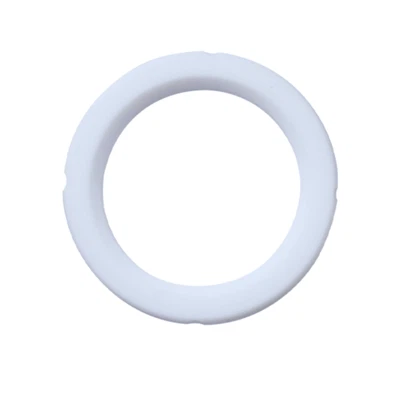
Polytetrafluoroethylene (PTFE), commonly known as Teflon, has been a staple in various industrial applications for its remarkable chemical resistance, low friction coefficient, and high thermal stability. Restructured Filled PTFE (RPTFE Teflon) Restructured Filled PTFE, a specialized form of PTFE, is engineered to enhance and modify these inherent properties. As a leading supplier of RPTFE Teflon, I am often asked about its suitability for optical applications. In this blog post, we will explore whether RPTFE Teflon can indeed find a place in the world of optics.
Understanding RPTFE Teflon
Before delving into optical applications, it is essential to understand what RPTFE Teflon is. RPTFE Teflon is created by restructuring and filling PTFE with various materials such as glass fibers, carbon, graphite, or bronze. These fillers are added to improve specific properties of PTFE, making it more suitable for demanding applications. For instance, glass fiber filling can enhance the mechanical strength and dimensional stability of PTFE, while carbon and graphite can provide better electrical conductivity and wear resistance. RPTFE Teflon is widely used in industries like automotive, aerospace, and chemical processing, where its unique properties offer significant advantages.
Key Properties of RPTFE Teflon Relevant to Optics
Transparency and Clarity
One of the most critical requirements for optical applications is transparency. Traditional PTFE has a relatively low transparency due to its highly crystalline structure. The fillers used in RPTFE Teflon can further reduce its transparency. However, depending on the type and amount of filler, it may still be possible to achieve a certain level of translucency. For example, if the filler particles are small and evenly dispersed, they may cause less light scattering, allowing some light to pass through. In applications where absolute clarity is not required, such as diffusers or light guides that need to scatter light evenly, RPTFE Teflon might be a viable option.
Chemical Resistance
Optical components are often exposed to various chemicals during manufacturing, cleaning, or in their operating environments. RPTFE Teflon's excellent chemical resistance makes it highly resistant to most acids, bases, and organic solvents. This property is crucial in protecting optical components from chemical degradation, ensuring their long - term performance and stability. For instance, in optical sensing applications where the sensor may come into contact with corrosive substances, RPTFE Teflon can provide a protective layer that prevents damage to the sensitive optical parts.
Low Friction and Wear Resistance
In optical systems that involve moving parts, such as lenses with adjustable focus or scanning mirrors, low friction and high wear resistance are essential. RPTFE Teflon's low friction coefficient reduces the energy required to move the parts, minimizing mechanical wear and tear. This can lead to smoother operation, longer service life, and reduced maintenance costs for the optical equipment. For example, in a high - precision optical positioning system, RPTFE Teflon bearings or guides can ensure accurate and reliable movement of the optical components.
Thermal Stability
Optical components can be exposed to a wide range of temperatures during their operation. RPTFE Teflon has a high melting point and excellent thermal stability, which allows it to maintain its mechanical and chemical properties over a broad temperature range. This is particularly important in optical applications where temperature variations can cause thermal expansion or contraction of materials, leading to misalignment or distortion of the optical components. For example, in outdoor optical surveillance systems that are exposed to extreme temperatures, RPTFE Teflon can be used in components to ensure stable performance.
Potential Optical Applications of RPTFE Teflon
Optical Sealing and Gasketing
In optical instruments, sealing is crucial to prevent the ingress of dust, moisture, and other contaminants. RPTFE Teflon's chemical resistance, low friction, and conformability make it an ideal material for optical sealing and gasketing applications. It can be used to create seals around optical chambers, lenses, and other sensitive components, ensuring a clean and stable optical environment. Its conformability allows it to adapt to irregular surfaces, providing a reliable seal even under low compression forces.
Optical Mounting and Alignment Components
RPTFE Teflon's low friction and high wear resistance make it suitable for use in optical mounting and alignment components. For example, it can be used as a bearing material in lens mounts, allowing for smooth and precise adjustment of the lens position. Its dimensional stability ensures that the optical components remain accurately aligned over time, even under mechanical stress or temperature variations.
Optical Diffusers
As mentioned earlier, although RPTFE Teflon may not have high transparency, its ability to scatter light can be utilized in optical diffusers. Diffusers are used to spread light evenly, reducing glare and improving the quality of illumination. RPTFE Teflon's unique structure can be engineered to scatter light in a controlled manner, making it a potential material for creating diffusers with specific light - scattering properties.


Challenges and Limitations
Transparency
The main challenge for using RPTFE Teflon in optical applications is its limited transparency. Most optical applications require a high degree of clarity, and the fillers in RPTFE Teflon can significantly reduce the amount of light transmission. While some level of translucency can be achieved, it may not meet the requirements of applications such as high - resolution imaging or precision optical measurement.
Optical Homogeneity
For many optical applications, a high degree of optical homogeneity is required. The presence of fillers in RPTFE Teflon can cause variations in the refractive index and light scattering properties, leading to non - uniform optical performance. Achieving the necessary optical homogeneity in RPTFE Teflon can be a significant challenge, especially for applications that demand high - precision optics.
Conclusion
In conclusion, while RPTFE Teflon has several properties that make it potentially suitable for optical applications, it also faces significant challenges, particularly in terms of transparency and optical homogeneity. However, there are still niche optical applications where its unique properties, such as chemical resistance, low friction, and thermal stability, can be exploited to provide solutions. For example, in applications where absolute clarity is not required, or where protection from chemicals and mechanical wear is crucial, RPTFE Teflon can be a valuable material.
As a supplier of RPTFE Teflon, we are constantly working on improving the material's properties to make it more suitable for a wider range of applications, including optics. If you are interested in exploring the use of RPTFE Teflon in your optical projects, we invite you to contact us for a detailed discussion. Our team of experts can provide you with in - depth technical information, samples for testing, and customized solutions based on your specific requirements. Let's work together to find the best RPTFE Teflon solutions for your optical applications.
References
- "Handbook of Polytetrafluoroethylene (PTFE) and Related Fluoropolymers"
- Journal articles on advanced polymer materials for optical applications
- Technical reports on the properties and applications of RPTFE Teflon