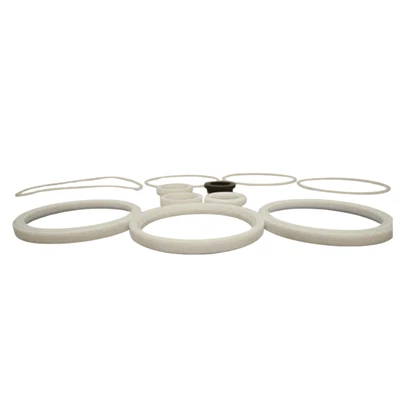
In the realm of valve manufacturing, the choice of materials is crucial for ensuring optimal performance, reliability, and longevity. One material that has gained significant prominence in recent years is Reinforced Polytetrafluoroethylene (RPTFE). As a leading supplier of RPTFE for valves, I am excited to delve into the standard specifications of RPTFE and explore why it has become the material of choice for many valve applications.


Understanding RPTFE
Before we dive into the specifications, let's first understand what RPTFE is. Polytetrafluoroethylene (PTFE), commonly known as Teflon, is a synthetic fluoropolymer with excellent chemical resistance, low friction coefficient, and high temperature stability. However, pure PTFE has some limitations, such as low mechanical strength and high creep under load. Reinforced PTFE addresses these limitations by incorporating fillers or reinforcements, such as glass fibers, carbon fibers, or bronze particles, into the PTFE matrix. This reinforcement enhances the mechanical properties of PTFE, making it more suitable for demanding valve applications.
Chemical Composition
The chemical composition of RPTFE is a key factor in determining its performance. The base polymer is PTFE, which provides the inherent chemical resistance and low friction properties. The type and amount of reinforcement used can vary depending on the specific application requirements. For example, glass fiber reinforcement is commonly used to improve the mechanical strength and dimensional stability of RPTFE, while carbon fiber reinforcement can enhance its thermal conductivity and wear resistance.
Physical Properties
The physical properties of RPTFE play a crucial role in its suitability for valve applications. Some of the key physical properties include:
- Density: The density of RPTFE typically ranges from 2.1 to 2.3 g/cm³, depending on the type and amount of reinforcement. A higher density generally indicates a higher concentration of reinforcement, which can result in improved mechanical properties.
- Hardness: RPTFE is available in a range of hardness levels, typically measured on the Shore D scale. The hardness can be adjusted by varying the type and amount of reinforcement, as well as the processing conditions. A harder RPTFE material may be more suitable for applications where high wear resistance is required.
- Thermal Conductivity: The thermal conductivity of RPTFE is relatively low, which can be beneficial in applications where heat transfer needs to be minimized. However, in some cases, such as high-temperature valve applications, a higher thermal conductivity may be desired to prevent overheating. Carbon fiber reinforcement can be used to increase the thermal conductivity of RPTFE.
- Coefficient of Friction: One of the most significant advantages of RPTFE is its low coefficient of friction. This property allows for smooth operation of valves, reducing wear and tear on the valve components and minimizing the energy required to open and close the valve.
Mechanical Properties
The mechanical properties of RPTFE are essential for ensuring the structural integrity and performance of valves. Some of the key mechanical properties include:
- Tensile Strength: The tensile strength of RPTFE refers to its ability to withstand pulling forces without breaking. Reinforcement can significantly improve the tensile strength of RPTFE, making it more resistant to deformation and failure under load.
- Compressive Strength: Compressive strength is the ability of RPTFE to withstand compressive forces without being crushed. This property is particularly important in valve applications where the material may be subjected to high pressures.
- Flexural Strength: Flexural strength measures the ability of RPTFE to withstand bending forces. A high flexural strength is desirable in valve applications where the material may be subjected to mechanical stresses during installation or operation.
- Creep Resistance: Creep is the gradual deformation of a material under a constant load over time. RPTFE with good creep resistance is less likely to deform under long-term stress, ensuring the dimensional stability of the valve components.
Chemical Resistance
One of the primary reasons for using RPTFE in valve applications is its excellent chemical resistance. RPTFE is resistant to a wide range of chemicals, including acids, bases, solvents, and corrosive gases. This property makes it suitable for use in harsh chemical environments, where other materials may degrade or fail.
Temperature Resistance
RPTFE has a wide operating temperature range, typically from -200°C to +260°C (-328°F to +500°F). This makes it suitable for use in both low-temperature and high-temperature valve applications. However, the specific temperature range may vary depending on the type and amount of reinforcement used. For more information on RPTFE Low Temperature applications, you can visit our website.
Sealing Performance
In valve applications, the sealing performance is of utmost importance. RPTFE's low friction coefficient and excellent chemical resistance make it an ideal material for valve seats and seals. It can provide a tight seal, preventing leakage and ensuring the efficient operation of the valve. For more details on RPTFE Seat Material, please refer to our website.
Processing and Fabrication
RPTFE can be processed and fabricated using a variety of methods, including machining, molding, and extrusion. Machining is a common method for producing custom valve components with precise dimensions. Molding and extrusion are suitable for mass-producing standard valve parts. The processing conditions, such as temperature and pressure, need to be carefully controlled to ensure the quality and performance of the final product.
Quality Control
As a supplier of RPTFE for valves, we adhere to strict quality control measures to ensure that our products meet the highest standards. We conduct comprehensive testing on our RPTFE materials, including physical, mechanical, and chemical property testing. This ensures that our customers receive high-quality RPTFE products that are reliable and perform as expected.
Applications
RPTFE is widely used in various valve applications, including:
- Chemical Processing: In the chemical industry, valves are often exposed to corrosive chemicals. RPTFE's excellent chemical resistance makes it an ideal material for valves used in chemical processing plants.
- Oil and Gas: In the oil and gas industry, valves are subjected to high pressures and harsh environments. RPTFE's high mechanical strength and temperature resistance make it suitable for use in oil and gas production, refining, and transportation.
- Food and Beverage: In the food and beverage industry, valves need to be made of materials that are safe for contact with food. RPTFE is a non-toxic and FDA-approved material, making it suitable for use in food and beverage processing equipment.
- Pharmaceutical: In the pharmaceutical industry, valves need to meet strict quality and hygiene standards. RPTFE's chemical resistance and ease of cleaning make it a popular choice for valves used in pharmaceutical manufacturing.
Why Choose Our RPTFE for Valves
As a leading supplier of RPTFE for valves, we offer several advantages:
- High-Quality Products: We use only the highest quality raw materials and state-of-the-art manufacturing processes to ensure that our RPTFE products meet the strictest standards.
- Customization: We understand that different valve applications have different requirements. We offer customized RPTFE solutions to meet the specific needs of our customers.
- Technical Support: Our team of experts is available to provide technical support and advice on the selection and use of RPTFE for valves.
- Competitive Pricing: We offer competitive pricing without compromising on the quality of our products.
Conclusion
In conclusion, RPTFE is a versatile and high-performance material that offers numerous advantages for valve applications. Its excellent chemical resistance, low friction coefficient, high temperature stability, and good mechanical properties make it the material of choice for many valve manufacturers. As a leading supplier of RPTFE Teflon for valves, we are committed to providing our customers with high-quality products and excellent service. If you are in the market for RPTFE for your valve applications, we invite you to contact us to discuss your requirements and explore how our products can meet your needs. We look forward to the opportunity to work with you and contribute to the success of your valve projects.
References
- "Handbook of Plastic Materials and Technology" by Irvin I. Rubin
- "Engineering Plastics: Properties and Applications" by Donald V. Rosato